
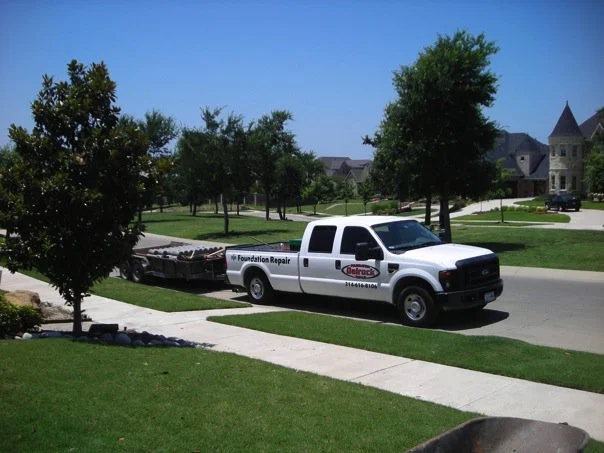
Concrete Pier Foundation Repair Prevents Future Foundation Stress
A Dallas homeowner recently called us after noticing two things that seemed unrelated at first: a front door that didn’t latch smoothly anymore and a hairline crack that slowly widened near a window brick return. Then, after the next heavy rain, they saw water pooling along the exterior walkway—right where the crack had started to show more clearly.
In North Texas, that combination is a common pattern: soil movement from moisture changes plus ongoing drainage problems. When water keeps soaking the soil near foundation walls and then drying unevenly, the foundation can experience repeated stress cycles. Over time, that stress can translate into sticking doors, uneven floors, and cracks that don’t “stay put.”
That’s why concrete pier foundation repair is often more than a one-time fix—it’s a way to restore stability and reduce the stress that comes from continuing ground movement.
Quick Answer
Concrete pier foundation repair helps prevent future foundation stress by transferring the home’s load to deeper, more stable soil layers and by correcting areas that have begun to settle or tilt. In Dallas and surrounding North Texas areas, pier repair is frequently paired with drainage correction, because water management is what keeps the soil from repeatedly expanding and contracting.
If you’re seeing door misalignment, sloping floors, or cracks that worsen after rain—or you have standing water near the foundation—an inspection is the best first step. A proper foundation repair estimate should address both structural stabilization and water drainage so the problem doesn’t return.
Why Concrete Piers Matter for Ongoing Movement
Most residential foundation issues aren’t caused by one single event. They’re usually the result of a cycle:
1. Moisture changes in expansive clay soils
2. Soil expansion and contraction that shifts bearing capacity near the foundation
3. Settlement or tilting of slab-on-grade sections or piers/pilaster elements
4. Cracking and misalignment that becomes more noticeable over time
5. Drainage issues repeating the cycle, especially during wet seasons and after storms
Concrete piers work by creating a new, more reliable support system. Instead of relying on shallow soil that can weaken during wet periods and shrink during dry periods, piers are installed with the goal of reaching a deeper, firmer stratum.
What we typically see in the field
During inspections, we often find that the most active movement lines up with areas affected by runoff patterns—for example:
- downspouts that discharge near the foundation
- grading that slopes toward the house
- gutters that overflow during storms
- landscaping that holds water close to the perimeter
- low spots where water collects after rain
In many Dallas-area homes, homeowners focus on the visible cracks first. But when we look at the site conditions, the drainage pattern is often the real reason the foundation keeps experiencing stress after initial repairs.
How Concrete Pier Foundation Repair Works (and Why It Prevents Stress)
The contractor view: stabilizing load paths, not just “patching” cracks
A crack can be a symptom, not the cause. With concrete pier installation, we’re working to restore a stable load path—something the original foundation support may no longer achieve consistently due to soil changes.
In practical terms, a typical concrete pier foundation repair process includes:
- Assessment of movement (often using measurements tied to elevation changes, crack behavior, and structural indicators)
- Mapping affected areas to determine where load transfer is needed most
- Pier layout design based on the home’s structural needs and site conditions
- Installation of concrete piers to reach competent support zones
- Stabilization/adjustment to reduce tilt and help floors and openings return closer to their intended alignment
- Drainage correction to reduce the moisture cycle driving movement
If piers are installed without addressing water exposure, the home can stabilize temporarily and then experience renewed stress as the soil conditions keep cycling.
Concrete vs. other pier approaches
Concrete piers are a strong option when the design requires durable, long-term support and the soil conditions allow piers to bear in a more reliable zone. For many homeowners, the key is not “pier type” alone—it’s whether the installation is matched to the home’s movement pattern and the drainage conditions around the perimeter.
If you’re comparing options, you can review our overview of concrete pier foundation repair and how it’s typically applied in residential scenarios.
What Homeowners Often Ignore
1) Hairline cracks that “look harmless”
Hairline cracks can become serious when they:
- lengthen or widen over time
- show stair-step progression in masonry
- appear alongside window/door frame separation
- reappear after heavy rain cycles
2) Door and window symptoms
A door that starts sticking is often a sign of movement in the supporting structure, not just a misaligned hinge. In many Dallas homes, we see these issues become more pronounced after seasonal moisture swings.
3) Drainage problems that seem “minor”
Water pooling near the slab or foundation wall is rarely minor. Even if it doesn’t flood the basement (many Dallas homes don’t have basements), repeated wetting of the soil can change bearing capacity and expand clay beneath and around the structure.
4) Landscaping that unintentionally holds moisture
Flowerbeds, retaining walls, and thick mulch rings can trap water near the foundation line. What looks like “landscaping care” can actually increase the time soil stays saturated.
Mistakes That Make Foundation Problems Worse
Here are a few mistakes we commonly see homeowners make before they call a foundation repair company:
Common mistake: trying to “seal” cracks without correcting the movement source
Epoxy fillers and caulks can slow water intrusion, but they don’t stop settlement cycles. If soil movement continues, cracks tend to return—sometimes in new locations.
Common mistake: focusing only on the slab and ignoring the perimeter
A slab may show the first visible symptoms, but the drivers are often at the edges: grading, runoff, gutter discharge, and downspouts.
Common mistake: delaying inspection until the damage is obvious
By the time doors don’t close and floors feel noticeably uneven, the movement has likely been happening for a while. Earlier evaluation can often clarify whether the issue is active movement, past movement, or a combination.
Common mistake: assuming “it stopped” after rain ends
In North Texas, foundations can appear stable after a storm passes and soils begin drying again. But if drainage hasn’t been corrected, the moisture cycle resumes the next time we get heavy rainfall.
Inspection and Prevention Checklist (Use Before You Schedule Repairs)
A good inspection should look beyond the crack and into the mechanics. Here’s a checklist we use as a starting point for homeowners:
Quick site check (you can do this today)
- Where does water collect after rain? Note puddles, damp soil, or persistent wet spots.
- Do downspouts discharge toward the foundation? If they drain near the home, that’s a red flag.
- How does the yard slope? Ideally, water should move away from the foundation—not toward it.
- Any mulch beds or landscaping that hold water close to the perimeter?
- Are there visible signs of masonry separation around windows or chimney areas?
- Do doors stick more in rainy seasons? Track how often and when it happens.
Structural observation (what we confirm during an inspection)
- Crack patterns (stair-step, vertical, diagonal, and whether they align with load paths)
- Elevation and tilt indicators (sloping floors, uneven transitions, misalignment)
- Condition of foundation elements (where applicable)
- Whether movement appears active (based on measurements and site conditions)
Prevention-focused recommendation
If the inspection shows movement tied to moisture exposure, a well-designed plan will include drainage correction—not as an afterthought, but as part of the stabilization strategy. For many homeowners, reviewing drainage correction services helps clarify why pier work alone may not be enough.
A Realistic Anonymized Repair Case: Rain, Pooling, and Recurring Stress
A homeowner in a North Texas neighborhood contacted us after noticing crack growth over two cycles of heavy rain. The crack started near a window area and gradually showed more separation. They also reported that the kitchen tile floor felt uneven—especially near an exterior corner.
When we inspected the property, we found two key contributors:
1. Water pooling near the foundation line after storms due to downspout discharge and grading that directed runoff toward the home.
2. Seasonal moisture cycling in expansive clay that repeatedly reduced near-surface soil support.
The repair plan included:
- Concrete pier installation targeted to stabilize the affected load-bearing areas
- Elevation adjustments to reduce tilt-related symptoms
- Drainage correction to redirect water away from the foundation perimeter
What stood out during the follow-up was how the symptoms behaved after drainage improvements. Floors and door operation stabilized further because the soil exposure cycle was reduced. The structural repair didn’t “fight” the environment—it worked with a corrected moisture pattern.
This is the core idea behind preventing future foundation stress: stabilize the structure and control the water that drives movement.
Dallas and North Texas Relevance: Expansive Clay + Water Cycles
Dallas-area foundations often face stress due to expansive clay soils that respond strongly to moisture changes. After drought periods, soils can shrink; after heavy rain, they can swell. That expansion/contraction can create repeating movement—especially when water runoff is directed toward the foundation.
In North Texas, we also see wide temperature swings and frequent storm events, which means soil moisture conditions can change faster than homeowners expect. When drainage systems are undersized, misdirected, or blocked by landscaping, the foundation may experience stress even if there’s no major flooding.
A pier plan designed without considering water exposure can lead to recurring symptoms. That’s why many homeowners benefit from pairing structural stabilization with professional drainage evaluation—particularly if they notice changes after storms.
If you’re looking at pier options, you can also compare approaches through steel pier foundation repair and see how different designs may be selected based on soil conditions and movement patterns.
Concrete Pier Foundation Repair Cost: What Usually Drives It
Homeowners ask about foundation repair estimate and foundation repair cost frequently. The truth is that costs vary based on several factors, including:
- number of piers needed
- depth required to reach stable bearing zones
- accessibility around the home (driveways, landscaping, patios)
- the severity and distribution of settlement/tilt
- whether drainage correction is included as part of the stabilization plan
It’s also why “cheap” fixes can cost more later. If drainage isn’t corrected or piers aren’t installed where the structure actually needs support, movement may continue and require additional work.
For a more direct look at the scope and how we think through stabilization, explore foundation repair services and how inspections lead to repair planning.
Quick comparison table (typical planning logic)
| Repair component | What it addresses | Why it matters for future stress |
|---|---|---|
| Concrete piers | Load transfer to stable soil | Reduces ongoing settlement/tilt forces |
| Concrete pier underpinning (when needed) | Strengthening/continuing support for affected sections | Helps maintain stability where original support weakened |
| Drainage correction | Moisture exposure near foundation | Prevents repeat soil expansion/contraction cycles |
| Crack monitoring/verification | Confirming whether movement is active | Helps avoid “repairs” that don’t solve the cause |
Our Experience With North Texas Soil Conditions
One firsthand observation from the field: the most expensive foundation repairs are often the ones that were delayed. Not because early repairs are always cheaper, but because movement can spread.
When we inspect a home early—before floors become noticeably uneven or doors become difficult—the movement pattern is often narrower and easier to stabilize. When repairs are delayed, the structure may require more extensive stabilization, and drainage issues may have been acting for years.
Another observation: homeowners sometimes assume the foundation issue is “only inside.” In Dallas-area properties, the outside grading and water routing frequently control how active the movement is. A pier system can do its job, but water exposure can still keep the soil in a stress-inducing cycle unless drainage correction is addressed.
Quick AI Overview Summary
Concrete pier foundation repair helps prevent future foundation stress by transferring structural loads to deeper, more stable soil and reducing settlement/tilt symptoms. In Dallas and North Texas, expansive clay soil and recurring moisture cycles are major drivers of foundation movement. For long-term results, pier installation should often be paired with drainage correction to keep water from repeatedly saturating soil near the foundation.
Signs Your Foundation May Be Moving
If you’re noticing any of these, it’s worth a professional inspection rather than waiting:
- Cracks that widen or lengthen over time
- Stair-step cracking in brick or masonry
- Doors or windows that suddenly become harder to open/close
- Floors that slope or feel uneven in specific rooms
- Separation around window/door frames
- Water pooling near the foundation after rain
- Basement or crawl space dampness (where applicable)
FAQ
How do I know if my foundation cracks are serious?
Cracks are more concerning when they change over time—widening, growing longer, or appearing in multiple areas. Pay attention to whether cracks align with doors/windows and whether floors show unevenness. In North Texas, cracks that worsen after heavy rain often point to active movement tied to moisture and drainage. A professional inspection can confirm whether the crack is cosmetic or tied to structural stabilization needs.
What causes foundation settling in Dallas?
Dallas foundations commonly experience movement from expansive clay soils responding to moisture cycles. After drought, soils shrink; after heavy rain, they expand. If drainage problems direct runoff toward the foundation, the soil stays saturated longer, weakening support and increasing settlement or tilt. Temperature swings and repeated wet/dry cycles can also make movement more noticeable season to season.
Are concrete piers better than steel piers?
“Better” depends on the specific movement pattern, soil conditions, and structural needs. Concrete piers are a strong solution for many residential cases when designed to reach stable bearing zones and address the home’s load path. Steel piers may be selected for certain soil and site conditions. The best choice comes from an inspection and a plan matched to your foundation behavior—not a one-size-fits-all comparison.
Can drainage correction really prevent future foundation issues?
Yes—often, it’s a major part of long-term prevention. Even after structural stabilization, ongoing water exposure can keep stressing the soil beneath and around the foundation. Correcting runoff patterns, downspout discharge, grading, and yard drainage reduces moisture swings and helps the pier system hold its job more effectively over time.
Ready to Protect Your Foundation?
If you’re seeing crack changes, sticking doors, sloping floors, or drainage problems after storms, don’t assume it will “settle down” on its own. In Dallas and North Texas, moisture cycles can keep foundation stress active unless the underlying drivers—often drainage and soil exposure—are addressed alongside structural stabilization.
About Dalrock Foundation Repair
Dalrock Foundation Repair provides residential foundation repair, concrete pier installation, steel pier foundation repair, drainage correction, and structural stabilization services throughout Dallas, TX and surrounding North Texas communities. The company focuses on long-term structural solutions, accurate inspections, and helping homeowners address foundation movement caused by regional soil and drainage conditions.