
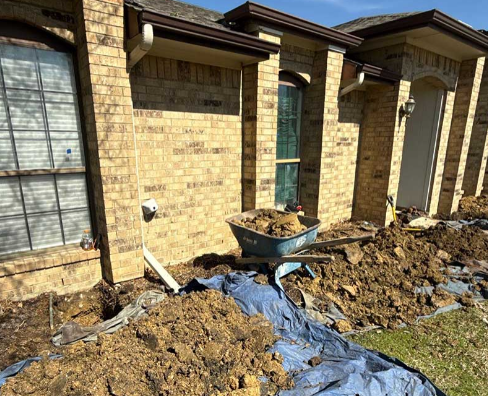
Drainage Correction and Foundation Repair: A Smart Pairing
On a typical Dallas spring day, a fast-moving storm can drop an inch of rain in under an hour. For many homeowners, that water doesn’t just run off — it pools along the foundation, seeps into the soil, and quietly starts a chain reaction. Months later, they notice new cracks in the drywall, doors sticking, or brick mortar separating. By the time a contractor is called, the problem is no longer just drainage or just the foundation. It’s both.
In North Texas, where expansive clay soils swell when wet and shrink when dry, the relationship between water management and structural stability is direct and unforgiving. Studies show that up to 60% of residential foundation movement in clay-heavy regions is related to moisture changes in the soil. In Dallas, that number may be even higher because of our intense wet-dry cycles.
This article explains why pairing drainage correction with foundation repair is often the smartest, most cost-effective move for Dallas homeowners. You’ll learn how poor drainage accelerates foundation problems, what proper correction looks like, how different pier systems compare, and how to protect your investment for the long term.
Key Insight: Addressing foundation issues without fixing drainage is like patching a roof leak without replacing the rotten decking. The visible problem may be repaired, but the underlying cause keeps working against you.
Why Water is Your Foundation’s Biggest Enemy in Dallas
Dallas sits on highly expansive clay soils that react dramatically to moisture. When the soil is saturated, it swells and pushes upward on your foundation. When it dries out, it contracts and pulls away, allowing your house to settle and shift. Over time, this cycle can cause the very problems that lead people to search for house foundation repair and residential foundation repair.
A common scenario we see across neighborhoods from Lake Highlands to Grand Prairie goes like this:
- Gutters are missing, clogged, or discharging right at the base of the house.
- Grading slopes toward the foundation instead of away from it.
- Downspouts dump water onto small concrete splash blocks that are too close to the home.
- Sprinklers overwater beds near the foundation, adding to the problem.
After a few seasons, homeowners notice diagonal cracks over windows, gaps between the baseboards and floor, or a sloping feel to certain rooms. An inspection often reveals that the soil along one side of the home has been repeatedly saturated, causing differential movement — one part of the foundation moving more than another.
“Water is both the lifeblood and the enemy of Dallas clay soils. Control it, and you control most foundation movement.” — Local Structural Engineer, Dallas
A recent Dalrock project in North Dallas involved a 1970s brick home where the back patio turned into a shallow pond every heavy rain. The homeowner called us for a foundation repair estimate after noticing cracks in the brick and interior sheetrock. Our assessment showed that the rear foundation had settled more than an inch due to chronic saturation. We stabilized the structure with piers — but the long-term solution also required regrading the yard and installing surface drains to redirect stormwater away from the house.
CALLOUT: If water regularly stands near your foundation for more than 24–48 hours after rain, you’re not dealing with a cosmetic drainage issue — you’re looking at a structural risk over time.
How Drainage Problems Turn into Foundation Damage
Poor drainage and foundation movement are often two chapters of the same story. Understanding the progression helps you see why drainage correction and structural repairs should be planned together.
The Typical Progression
- Stage 1: Surface Symptoms
Water pools near the house. Mulch beds wash out. Soil erodes at downspout outlets. You might notice algae or mildew on lower brick courses.
- Stage 2: Soil Movement
Saturated soil swells, lifting or pushing against parts of the foundation. When it eventually dries, it shrinks and pulls away, creating voids and uneven support.
- Stage 3: Structural Movement
The foundation begins to tilt, rotate, or settle in sections. Doors stick, windows don’t close properly, and small cracks appear in drywall and exterior brick.
- Stage 4: Structural Damage
Cracks widen, floors feel uneven, and the home may require significant structural foundation repair and foundation leveling to restore stability.
One East Dallas homeowner called Dalrock after noticing a ¼” crack zig-zagging through her brick veneer near a downspout. Our inspection showed the soil there was constantly wet, and the grade funneled water toward the foundation. Over five years, that side of the house had settled nearly 1½ inches.
We corrected the slope of the yard, extended downspouts, and installed area drains to capture and redirect water. Then we installed piers along the affected wall to lift and support the settled section. Had drainage been addressed when the first pooling appeared, the cost of foundation repair could have been significantly lower.
As you can see, water management and structural stability are not separate issues. They’re phases of the same process — and dealing with them together is more efficient and more durable than tackling them in isolation.
Pairing Drainage Correction with Pier Systems: Steel vs. Concrete
Once drainage is addressed or planned, the next question is how to stabilize the foundation itself. In Dallas, two common solutions are steel pier foundation repair and concrete pier foundation repair. Both can be effective when properly designed and installed, but they behave differently in our soils and have different cost and performance profiles.
Dalrock offers both steel pier foundation installation and concrete pier foundation installation, allowing us to match the system to the specific home, soil conditions, and budget.
Here’s a simplified comparison:
| Aspect | Steel Piers | Concrete Piers |
|---|---|---|
| Typical Depth in Dallas | Deeper, often to bedrock or very firm strata | Shallower, usually seated in upper clay layers |
| Load Capacity | Higher; excellent for heavier structures | Moderate; suitable for many residential homes |
| Installation Disruption | Smaller footprint; less excavation | Larger holes; more yard and landscaping impact |
| Long-Term Performance | Very stable in variable moisture soils | Good, but more influenced by soil moisture changes |
| Typical Local Cost Range | Higher steel pier foundation cost per pier | Lower concrete pier foundation cost per pier |
| Best Use Cases | Severe movement, high loads, long-term stability | Moderate movement, budget-conscious repairs |
\Actual costs depend on pier count, access, and site conditions; a detailed foundation repair estimate is always recommended.
A recent project in Plano is a good illustration. The homeowner had extensive settlement on one corner, with 2″ of drop and clear signs of differential movement. Drainage along that side was poor — water flowed directly toward the slab during storms. After designing a plan to redirect surface water with swales and drains, we installed a system of steel piers along the failing perimeter. Because steel piers reach deeper, more stable layers, they were ideal for this level of movement.
“Think of steel piers as long-term anchors and concrete piers as solid props. Both can work, but the right choice depends on how hard the soil is working against you.” — Dalrock Foundation Specialist
In other cases — such as a smaller Dallas bungalow with mild settling and manageable drainage issues — concrete piers paired with grading corrections can provide a solid, cost-effective solution.
Modern Drainage Correction: Beyond Splash Blocks and Gutters
Many homeowners assume that adding a couple of splash blocks or a new gutter run is all that’s needed to solve drainage problems. In reality, effective foundation drainage correction often requires a more engineered approach, especially when tied to foundation work.
Modern yard drainage correction in Dallas typically includes some combination of:
- Regrading and Swales
Reshaping soil so it slopes gently away from the home (usually 5% slope for the first 5–10 feet). Shallow swales or channels can guide water toward safe discharge points.
- Surface Drains and Catch Basins
Installed in low spots where water tends to pool, these collect runoff and convey it through buried piping away from the foundation.
- French Drains (in select situations)
Perforated pipes surrounded by gravel, used to intercept and redirect subsurface water. These must be carefully designed to avoid moving water where it creates new problems.
- Downspout Extensions and Underground Leaders
Redirecting roof runoff well away from the foundation, often 10–20 feet or more, especially on low-slope lots.
A Lakewood-area homeowner called Dalrock for “minor” drainage problems around foundation — water was consistently ponding along the side yard and creeping into the crawlspace. The house had just undergone concrete pier underpinning from another contractor, but drainage had been ignored.
We evaluated the site and designed a combination of regrading, surface drains, and extended downspouts. Within one rainy season, the crawlspace moisture levels dropped significantly, and no new cracks or movement were observed. The previous foundation work was finally protected by proper water management.
Modern drainage correction is not about overengineering; it’s about making sure the water that naturally falls on your roof and yard has a predictable, safe path away from your home.
Cost, Value, and Long-Term ROI in Dallas
Homeowners understandably worry about foundation repair cost and how much additional drainage work will add. The better question is: what is the cost of not addressing drainage when you repair the foundation?
Typical Local Cost Ranges
While every property is different, Dallas-area homeowners can expect:
- Basic grading and gutter adjustments: lower end of the spectrum
- Moderate drainage systems (surface drains, extensions): mid-range investment
- Comprehensive drainage plus piers: higher initial cost, but often the best long-term value
Here’s a high-level comparison of traditional “foundation-only” repairs versus integrated drainage + foundation solutions:
| Approach | Short-Term Cost (Dallas) | Long-Term Risk | Typical Lifespan Impact |
|---|---|---|---|
| Foundation piers only | Lower upfront | Higher risk of re-movement | May require additional work in 5–10 years |
| Drainage correction only | Lower to moderate | Foundation issues may continue | Helpful, but doesn’t fix existing structural issues |
| Combined drainage + piers (steel or concrete) | Higher upfront | Much lower risk of re-movement | Best chance of lasting stability |
A homeowner in Richardson once told us, “I wish I’d done the drainage the first time.” He had paid for partial cracked foundation repair five years earlier from another contractor that did not address obvious surface water issues. The same side of the house moved again. When he called Dalrock, we installed additional piers, but we also corrected grading and installed drains. The second repair cost more than if drainage had been included from the start.
“Foundation work should be a one-time investment whenever possible. Skipping drainage is the most common reason people end up paying twice.” — Dalrock Project Manager
When you consider the value of your home, especially in a competitive market like Dallas, protecting your foundation is not just a repair expense — it’s a long-term investment in resale value, safety, and peace of mind.
Choosing the Right Partner: Why Specialization Matters
Not all foundation repair contractors or steel pier underpinning contractors approach projects the same way. Some focus solely on piers and ignore water. Others offer generic drainage solutions without fully understanding how they interact with a slab or pier-and-beam structure.
For Dallas homeowners, the ideal partner is a foundation repair company that:
- Understands expansive clay soils and local building practices.
- Offers both steel pier foundation contractors and concrete pier foundation contractors so they’re not locked into a one-size-fits-all system.
- Provides integrated drainage correction services with a clear plan for handling runoff.
- Uses industry best practices and adheres to engineering recommendations when needed.
- Stands behind their work with meaningful warranties and a long-standing local presence.
A recent Dalrock project in Far North Dallas involved a homeowner who had three different “experts” give conflicting advice: one said “just gutters,” another recommended “20+ piers,” and a landscaper suggested “a French drain everywhere.” Our evaluation showed moderate movement on one side of the home, driven mostly by a combination of negative slope and concentrated downspout discharge.
We recommended targeted piers along the affected wall, regrading to restore positive slope, and a simple surface drainage system. This integrated plan cost less than the “20+ piers everywhere” quote, solved the actual problem, and gave the homeowner a clear, documented path for long-term maintenance.
What This Means for Homeowners in Dallas
For Dallas-area homeowners, the pairing of drainage correction and foundation repair is not an optional upgrade. It’s a practical response to a very specific local reality: expansive clay soils, intense storms, and long dry spells.
Here’s what that means for you:
- Inspections Should Be Holistic
When you call for foundation repair services or start searching for foundation repair near me, expect a thorough evaluation that looks at both structural and water-related issues. A quick walk-around that only notes cracks without studying drainage is incomplete.
- Repairs Should Address Cause and Effect
Piers, underpinning, and other structural methods stabilize and level. Drainage systems manage the forces that caused the movement. You need both for a truly durable solution.
- Budgeting Should Consider Long-Term Costs
Choosing the lowest upfront bid that ignores drainage can be more expensive in the long run. Integrated plans may cost more initially, but they are designed to prevent repeat issues and protect your home’s value.
- Local Experience Matters
Dallas isn’t like other markets. What works in sandy or rocky regions doesn’t always translate to our clay-heavy soils. Working with local foundation repair specialists who understand neighborhoods from Oak Cliff to Frisco gives you a real advantage.
Finally, remember that not every sign of movement means you’re facing a major structural failure. Many issues are manageable when caught early and addressed with a balanced plan that respects both the structure and the soil. The key is to act sooner rather than later, especially when you see water consistently misbehaving around your home.
Frequently Asked Questions
Q: Do I really need drainage work if I’m already installing piers?
A: In most Dallas homes, yes. Piers address existing movement by transferring the home’s weight to deeper, more stable soils. However, if surface water continues to saturate the upper clay layers, you can still see soil heave, erosion, and stress on the structure between pier locations. Over time, this can lead to new cracks, uneven floors, or even the need for additional piers. Integrating foundation water drainage solutions with your pier system helps stabilize the moisture conditions around your home, reducing the risk of future movement and protecting your investment in foundation repair.
Q: How much does combined drainage and foundation repair typically cost in Dallas?
A: Costs vary widely based on the severity of movement, access, and the complexity of drainage needs. A simple grading adjustment and a few piers will be on the lower end, while extensive water drainage correction with a larger pier system — such as full-perimeter steel pier underpinning — will be higher. Many homeowners are surprised to find that a carefully designed combination plan can be more cost-effective than an “over-piered” foundation-only approach. The best way to understand your specific cost of foundation repair is to schedule a professional evaluation and written estimate.
Q: Can I just install French drains to fix my foundation issues?
A: French drains can be helpful in certain situations, but they are not a cure-all and can even cause problems if misused. They’re designed to intercept and redirect subsurface water, not to fix structural movement that has already occurred. If your home shows signs of settlement — such as cracks, sticking doors, or sloping floors — you likely need some form of foundation settling repair or underpinning in addition to drainage work. A qualified contractor should evaluate whether French drains, surface drains, or simple grading changes are most appropriate for your property.
Q: How do I know if my drainage problems are serious enough to affect the foundation?
A: Look for patterns and persistence. Occasional minor puddles that disappear within a few hours may not be critical. But if you consistently see water standing near your home for more than 24–48 hours after rain, noticeable erosion, or water flowing directly toward the slab, it’s time to be concerned. Combine that with interior symptoms — like new cracks, doors that won’t latch, or gaps between floors and baseboards — and you may need both drainage repair near me and structural foundation repair. A professional inspection can distinguish between cosmetic drainage issues and those threatening your foundation.
Q: Is steel always better than concrete for piers in Dallas?
A: Not always. Steel pier foundation repair offers excellent depth and load capacity, making it ideal for severe movement or heavier structures. However, well-designed concrete pier underpinning can be a strong, cost-effective solution for many homes with moderate settlement. The choice depends on soil conditions, the extent of movement, access, and budget. A reputable contractor that offers both systems will recommend what’s appropriate for your specific situation, rather than defaulting to a single method.
Q: How long should a properly done foundation and drainage repair last?
A: When designed and installed correctly, and with normal homeowner maintenance, a combined foundation and drainage solution should provide long-term stability — often for the remaining life of the structure. That’s why many Dallas homeowners look for foundation repair specialists who provide strong warranties on both piers and drainage components. Regularly maintaining gutters, monitoring grading, and avoiding overwatering near the foundation will help ensure that your investment in foundation repair services continues to perform for decades.
Q: When is the best time of year in Dallas to schedule this kind of work?
A: Foundation and drainage work can be done year-round in North Texas, but many homeowners schedule projects during drier months for convenience. That said, wet seasons can provide valuable information about how water behaves on your property, which helps design effective poor drainage solutions. Because reputable foundation repair contractors often book out during peak seasons, it’s wise to contact them as soon as you notice issues rather than waiting for “perfect” weather.
Ready to Get Started?
Water and time won’t wait. In Dallas, each heavy rain and each long dry spell adds a little more stress to your foundation. If you’re already seeing signs of movement or chronic drainage issues, pairing land drainage correction with professional foundation repair is one of the smartest steps you can take to protect your home.
Dalrock Foundation Repair has been helping Dallas-area homeowners stabilize their homes and solve drainage problems around foundation for years. Our team evaluates both the structure and the site, so your solution isn’t just a quick fix — it’s a coordinated plan tailored to your property, soil, and budget.
The next step is simple: schedule an on-site evaluation. We’ll walk your property, study how water moves around your home, assess any foundation movement, and provide a clear, written proposal. No guesswork, no one-size-fits-all packages — just experienced guidance and practical options.
About Dalrock Foundation Repair
Dalrock Foundation Repair is a locally owned and operated specialist serving Dallas, TX and the surrounding communities. With decades of experience on North Texas clay soils, we provide comprehensive foundation repair services, including steel pier foundation installation, concrete pier foundation repair, and integrated drainage correction. Our team is committed to honest evaluations, high-quality workmanship, and solutions designed to last in the demanding Dallas climate. Learn more about our approach and services at our main website.