
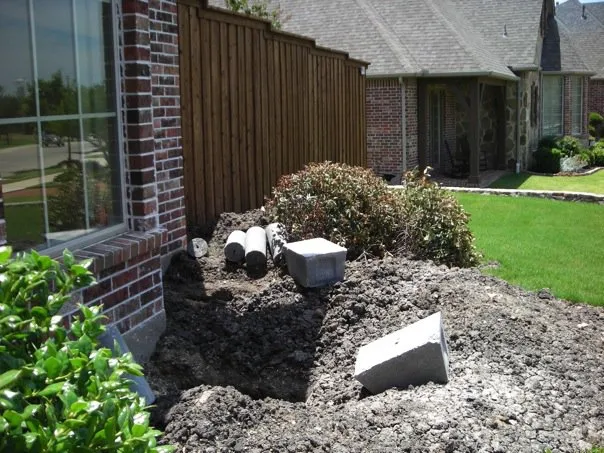
Drainage Correction Solutions to Protect Foundation Integrity
Last August, a homeowner in North Texas called after a heavy storm left their yard waterlogged for days. The surprising part wasn’t the puddles—it was what happened afterward. Over the next few weeks, they noticed a new hairline crack near a window and a slightly sticking front door. Nothing looked “catastrophic,” but the timing was too consistent to ignore: the cracks showed up after the water sat against the house.
In Dallas-area soil, that pattern matters. When water can’t drain away properly, it changes soil moisture around your foundation. On expansive clay, even small shifts in moisture can translate into movement—sometimes subtle at first, but persistent if drainage doesn’t get corrected.
Quick Answer
Drainage correction protects foundation integrity by stopping the soil moisture swings that cause settling, shifting, and slab movement. A proper plan usually combines:
- grading/flow adjustments so water moves away from the home
- fixing downspouts, gutters, and surface runoff
- addressing yard drainage issues (low spots, swales, or pooling)
- correcting foundation water pathways that feed the soil around piers, beams, or slabs
Structural repairs (like drainage correction) often last longer when drainage is corrected first or alongside any stabilization work.
What Homeowners Often Ignore
Most homeowners focus on the visible damage—cracks in brick, drywall, or a sloped tile floor. But in practice, we see a different starting point more often than you’d expect: the foundation is reacting to water.
Common “ignored” drainage clues we find during inspections include:
- water pooling near one side of the house after rain
- damp crawlspace areas or persistent moisture smell
- soil that stays darker or spongier next to the foundation
- downspouts that discharge too close to the home
- landscaping beds that act like a sponge against exterior walls
- grading that slopes toward the foundation instead of away
How Drainage Problems Turn Into Structural Movement
Here’s the contractor-level explanation we give homeowners: your foundation system depends on stable soil support. When water is consistently added (or trapped) near the foundation, expansive clay can swell. When it later dries unevenly, it can shrink. That cycle can lift one area, allow another to settle, and gradually create stress that shows up as:
- cracks that grow over time (especially near corners and openings)
- doors or windows that stop latching smoothly
- uneven floors that become more noticeable season to season
- minor settlement that becomes more pronounced after repeated wet/dry cycles
Firsthand observation from our crews
In the field, we often find that “structural repair” fixes only one part of the problem. For example, a slab may be stabilized, but if water continues to feed the same soil zone, we’ll see additional movement patterns after the repair—sometimes not immediately, but after the next major rain cycle. That’s why our team treats drainage correction as a core part of long-term stabilization planning.
Signs Your Foundation May Be Moving
You don’t need dramatic cracking to have a movement problem. Look for patterns that change after weather events:
- Cracks that appear or widen after heavy rain or drought
- Cracks near windows/doors (especially diagonal or stair-step in brick)
- New sticking doors or windows
- Gaps around exterior trim that weren’t there before
- Sloped floors that worsen over time
- Water pooling along one side of the home
- Bowing or leaning in exterior masonry (more serious if increasing)
If you’re seeing more than one of these—particularly when they correlate with rain—you’re not just dealing with cosmetic issues. You’re likely dealing with ongoing soil moisture movement.
Mistakes That Make Foundation Problems Worse
1) Assuming hairline cracks are always “fine”
Hairline cracks can be non-structural. But what matters is whether they’re stable or active. We see homeowners repaint and patch cracks without addressing the moisture trigger—then the crack returns after the next storm.
2) Fixing the foundation without fixing the water pathway
Structural stabilization can improve support, but it can’t stop soil moisture cycles by itself. If downspouts discharge at the wrong angle, gutters overflow, or grading directs runoff toward the house, the surrounding soil can continue to move.
3) Landscaping that looks nice but holds water
Deep mulch beds, thick soil amendments, or “pretty” berms can unintentionally create a water trap against the foundation. Even a small low area in the yard can become a repeated soaking point.
4) Waiting for major damage before calling
By the time movement becomes obvious (sticking doors, persistent floor slope), the problem may already be repeating through multiple wet/dry cycles. Early evaluation is usually the most cost-effective path.
Drainage Correction Solutions That Actually Protect Stability
Drainage correction isn’t one universal fix. It’s a set of targeted improvements based on where water is coming from and where it’s going.
Typical drainage correction components we evaluate
- Downspout extensions or redirection so roof water discharges farther from the foundation
- Gutter downspout management (preventing overflow during Texas storms)
- Surface grading adjustments to promote runoff away from the home
- Yard drainage correction for low spots, swales, or persistent pooling
- Perimeter water management where runoff concentrates near exterior walls
- Soil and landscaping changes that reduce water retention near foundation edges
When structural support is also needed
Sometimes drainage correction alone isn’t enough—especially if the foundation has already experienced settlement. In those cases, we may recommend structural stabilization alongside drainage improvements, such as pier installation.
If you’re exploring stabilization options, you can review our approach to steel piers, concrete pier, or the broader foundation repair services we coordinate when drainage is part of the solution.
Realistic Example: What “Good” Looks Like (Anonymized Case)
A homeowner reported recurring water pooling along the front-right corner after storms. They also had a small crack near a bedroom window and slight door sticking during humid weeks.
During inspection, we found that:
- the yard slope directed runoff toward the foundation
- the downspout discharge point was too close
- the soil at the exterior edge stayed saturated longer than other areas
- interior cracking aligned with the exterior water concentration
Repair plan:
1. Corrected surface grading to move runoff away from the foundation.
2. Redirected downspouts to discharge farther from the home.
3. Adjusted landscaping to stop water retention against the foundation edge.
4. Stabilized the affected support area to address existing movement (rather than relying on drainage alone).
Outcome: After the next heavy rain, water no longer pooled at the same spot, and the homeowner reported that doors stopped sticking as noticeably. The crack stopped progressing because the soil moisture trigger was removed and the structure had improved support.
Our Experience With North Texas Soil Conditions
Dallas and surrounding areas frequently experience the combination that stresses foundations most:
- long dry spells (expansive clay shrinks)
- followed by intense rain events (clay swells)
- plus major temperature swings that change seasonal moisture behavior
That’s why we treat drainage correction as a stability strategy, not just a landscaping improvement. When homeowners ask about foundation repair cost or how long repairs “last,” we often explain that the durability of stabilization depends heavily on moisture control around the foundation.
Industry guidance also supports this broader approach. Foundations are engineered to work with predictable soil conditions—when moisture levels fluctuate, movement risk increases. That’s consistent with how civil engineers and geotechnical professionals discuss expansive soils: moisture management is central to long-term performance.
For additional context on structural stabilization options, homeowners often compare pier systems like steel pier foundation installation and concrete pier foundation installation, which is why we offer clear guidance on drainage correction services alongside pier recommendations when needed.
Inspection & Prevention Checklist (Do This Before You Assume It’s “Just Cracks”)
If you want to prepare for an inspection—or evaluate whether drainage is likely involved—use this checklist:
Foundation & symptom checks
- Track cracks: take photos and note dates (especially after storms)
- Check doors/windows: do they stick after rain or during humidity?
- Look for new gaps around trim or exterior brick
- Observe floor changes: any localized slope that worsens over time?
Water & drainage checks
- After a heavy rain, walk the exterior perimeter:
- Where does water pool?
- Which side saturates longer?
- Check downspouts:
- Are they discharging too close?
- Are they overflowing?
- Look at yard grade:
- Does the soil slope toward the foundation?
- Are there low spots that repeatedly collect water?
- Inspect landscaping:
- Are beds holding water against the foundation edge?
Prevention notes
- Keep gutters flowing and downspouts directed away from the home
- Avoid diverting surface water toward the foundation when doing yard changes
- Don’t rely on patching cracks alone if water issues remain
Drainage Correction vs. Structural Repair: What’s the Difference?
Quick comparison
| Approach | What it addresses | When it’s usually enough | What it can’t do alone |
|---|---|---|---|
| Drainage correction | Soil moisture swings and water pathways | Early signs, active pooling, minor movement | If the foundation has already lost support capacity |
| Structural stabilization (pier/beam) | Support and load transfer | When movement has affected the structure | Stops soil movement only if paired with drainage control |
In many Dallas-area homes, the best results come from addressing both. Drainage correction reduces the “cause,” while structural repairs address the “effect” already present in the foundation system.
Dallas/North Texas Relevance: Why Water Control Matters Here
North Texas expansive clay doesn’t behave the same way as lighter, sandier soils. Instead, it reacts strongly to moisture changes—swelling when it’s wet and shrinking when it dries.
That means:
- foundation movement may not be constant—it can be seasonal
- symptoms often show up after storms or during humidity shifts
- repairs that ignore drainage can face recurring movement
If you’re looking for foundation repair near me and wondering why drainage keeps coming up, this is why: in our experience, water management is often the missing piece that determines whether foundation leveling and stabilization hold up over the long term.
FAQ
How do I know if my drainage issue is affecting my foundation?
If you notice water pooling near the foundation after storms, damp areas along exterior walls, or cracks that appear/widen following rain events, drainage is likely contributing. The correlation between weather and structural changes is a major indicator we look for during inspections.
Can drainage correction stop foundation settling completely?
It can stop or slow movement when the underlying cause is moisture imbalance. However, if the foundation has already lost support or experienced measurable settlement, drainage correction is usually most effective when paired with structural stabilization.
What’s the most common mistake homeowners make with foundation cracks?
A common mistake is patching or repainting cracks without identifying whether they’re active. If water continues to pool or run toward the foundation, the same movement pattern can return after the next wet/dry cycle.
Are steel piers or concrete piers better for homes with drainage problems?
Neither type replaces the need for drainage control. The best pier choice depends on soil conditions and the foundation’s support requirements. We typically coordinate pier recommendations with drainage correction so the soil moisture trigger doesn’t undermine long-term results.
Ready to Protect Your Foundation?
If you’re seeing cracks that appear after storms, doors that stick seasonally, or water pooling near your home, the next step is a focused inspection of both the foundation and the drainage pathways around it. Early evaluation helps you choose the right repair plan—often preventing repeat movement and reducing the likelihood of costly rework.
About Dalrock Foundation Repair
Dalrock Foundation Repair provides residential foundation repair, pier installation, drainage correction, and structural stabilization services throughout Dallas, TX and surrounding North Texas communities. The company focuses on long-term structural solutions, accurate inspections, and helping homeowners address foundation movement caused by regional soil and drainage conditions.