
Revive Stability with Expert Foundation Repair Strategies
Last summer, a homeowner in a North Texas neighborhood called us after noticing something that didn’t feel “cosmetic.” A few months earlier, the front entry door had started sticking slightly. Then, after a couple of heavy rain events, a hairline crack appeared near a window brick surround—and the crack seemed to widen after the ground dried out. Inside, they also saw a faint sloping line in the ceiling near the same wall.
In Dallas-area homes, that combination—seasonal door friction, new or widening cracks, and the timing that matches rain and drought cycles—often points to two connected issues: foundation movement and water/drainage behavior around the slab or piers. Solving only one side (for example, patching cracks) rarely restores long-term stability when soil moisture is still driving movement.
Quick Answer
If you’re seeing cracking, sticking doors, uneven floors, or water pooling near your foundation, you likely have movement that needs a proper inspection—not just cosmetic repair. In Dallas, expansive clay soils expand and contract with moisture changes, so successful foundation repair usually pairs structural stabilization (like pier installation and/or foundation leveling) with drainage correction to control water around the home.
A reliable foundation repair company will:
- inspect the crawl space or slab areas,
- evaluate soil and moisture patterns,
- determine the cause (often drainage + soil movement),
- recommend the right repair strategy (not a one-size-fits-all fix),
- provide a foundation repair estimate that matches the actual problem.
What We Commonly See in Dallas Foundations
From our field work, the pattern is usually consistent: homeowners focus on visible cracks, while the underlying trigger is frequently moisture movement in the soil.
Signs that often show up together
- Cracks that appear or change after weather swings (heavy rain, then drought)
- Doors or windows that start sticking or don’t latch smoothly
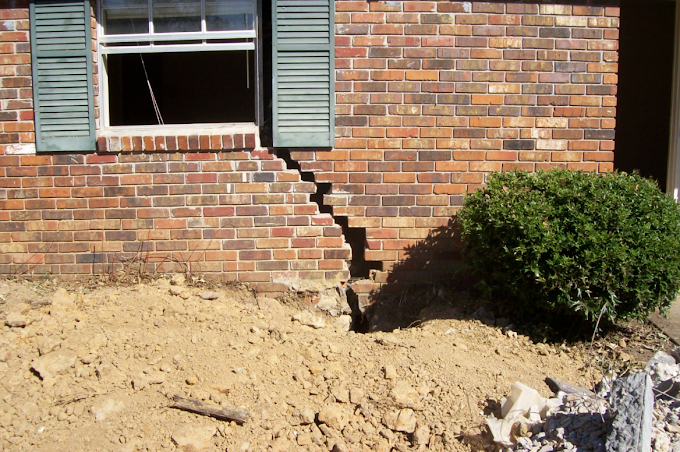
- Gaps around window frames or separation in brick veneer
- Uneven tile/laminate that becomes more noticeable over time
- Water pooling near downspouts, sidewalks, or low spots in the yard
Firsthand observation from the jobsite
One thing we routinely notice during inspections is how many homes have “fixed” drainage on paper—gutters installed, downspouts extended, maybe even a landscaping refresh—yet water still migrates toward the foundation during storms. It’s not always the direction of flow. Sometimes it’s the rate of flow (water overwhelms the path), the elevation (a low grade funnels runoff back toward the slab), or the soils’ response (clay holds moisture longer than expected). That moisture persistence can keep pushing the foundation out of alignment even after a structural repair begins.
Foundation Repair Strategies That Actually Stabilize
Every home is different, but stabilization usually falls into a few proven categories. The “right” option depends on what’s moving, how the structure is behaving, and what the soil is doing.
1) Foundation leveling and structural stabilization
When a slab or foundation has settled due to inadequate support, piers can transfer load down to more stable strata below the clay’s active zone. This is often what homeowners mean when they ask about foundation leveling.
2) Pier installation (steel or concrete)
In many Dallas-area scenarios, pier installation helps reduce ongoing settlement by providing deep support. Two common approaches are:
- steel pier foundation installation
- concrete pier foundation installation
The selection isn’t about “best material” alone. It’s about soil conditions, depth requirements, and how the foundation is currently responding.
If you want a structured overview of contractor options, you can explore our guidance on foundation repair company services and how we approach inspections.
3) Cracked foundation repair with a cause-first mindset
Cracks can be structural, non-structural, or somewhere in between. Our goal is to identify whether the crack is a symptom of movement still occurring. If drainage is still feeding moisture into the expansive clay cycle, then “cracked foundation repair” without drainage correction can lead to recurring stress.
4) Drainage correction as part of the repair plan
In North Texas, drainage is often the difference between a repair that holds for years and one that needs repeat attention.
When water control is improved, it helps reduce the soil expansion/contraction that drives movement. This is why we commonly pair structural stabilization with drainage correction services.
For a deeper look at the structural components, these pages are helpful:
- steel piers
- concrete pier
What Homeowners Often Ignore
The most expensive mistakes usually come from what’s not addressed.
Common mistake homeowners make
Waiting for cracks to become “big enough” to act—while the movement keeps cycling.
Hairline cracks are often dismissed because they look minor. But in expansive clay areas, repeated cycles can gradually shift the structure. By the time cracking is obvious, the foundation may have moved enough that partial repairs won’t correct the underlying geometry.
We also see another frequent mistake: attempting drainage solutions that don’t change where moisture ends up. For example:
- downspouts that dump close to the foundation,
- swales that look like they work but fail during intense storms,
- landscaping that slopes toward the home after a regrade,
- surface fixes that don’t address how water travels through clay.
Inspection and Prevention Checklist (What We Look For)
A strong foundation repair plan starts with a careful inspection. Here’s a homeowner-friendly checklist you can use before a site visit, and it also mirrors how we evaluate problems on the ground.
Quick inspection checklist
- Cracks
- Are they wider at one end or changing with seasons?
- Do they align with door/window openings or wall intersections?
- Doors and windows
- Do they stick when closing or show rubbing along the frame?
- Are gaps consistent or only after storms?
- Floors
- Do you notice tile/wood transitions that appear to “dip” near the foundation wall?
- Water behavior
- Does water pool near downspouts or in low spots after rain?
- Is there a consistent runoff path heading toward the home?
- Yard grading
- Is the soil around the foundation higher on the house side (a “bowl” effect)?
- Are there areas where mulch/soil has settled and created new low points?
- Previous repairs
- Were there past pier installations, slab patches, or crack repairs?
- If yes, did movement resume after the next wet season?
What this tells us
This checklist helps identify whether you’re dealing with structural settlement, moisture-driven movement, or both. In many Dallas-area homes, it’s both—so the inspection must include drainage correction considerations, not just structural components.
A Realistic Example: When Drainage Was the Hidden Driver
Here’s an anonymized case based on work we’ve performed in the region.
Home scenario: A single-story home with a shallow slab and brick exterior. The homeowner reported that a crack appeared near a window after a prolonged dry period, then “stepped” slightly during a subsequent heavy rain. They also noticed dampness in the soil near the foundation line after storms.
What we observed during inspection:
- The crack pattern corresponded with a wall section that experienced seasonal stress.
- Door closing friction increased after rain, then eased somewhat during dry weeks.
- The yard had minor grading changes after landscaping and new sod. Water didn’t necessarily “flood,” but it kept re-wetting the clay near the foundation.
Repair strategy:
- Structural stabilization using piers to address the load transfer and reduce ongoing settlement.
- Drainage correction to redirect runoff and control moisture around the foundation line.
Outcome: After the drainage improvements stabilized moisture behavior, the homeowner reported that doors became easier to align and the crack stopped showing noticeable change between wet and dry cycles.
The takeaway: structural repair addressed the movement, but drainage correction reduced the repeating trigger.
Dallas / North Texas Relevance: Why Soil Moisture Matters Here
Dallas-area foundations are often challenged by regional soil behavior. Many neighborhoods sit on expansive clay, which expands when it’s wet and contracts as it dries. Add Dallas’s heat swings and the reality that heavy rain can be intense, uneven, and short-lived—and you get a cycle that can create ongoing foundation settling or leveling issues.
In practice, this means:
- A repair that relies only on surface patching may not last.
- A pier installation can succeed structurally, but moisture control still determines how often movement resumes.
- Drainage problems around the foundation (even “small” ones) can keep the soil active and reactive.
If you’re trying to decide whether to focus first on structure or yard drainage, we typically recommend a combined, cause-first approach. It’s the most reliable way to stop the cycle, not just cover the symptoms.
Foundation Repair vs Monitoring
Sometimes homeowners want to know whether they should repair now or monitor. Here’s a practical way to decide.
Foundation Repair vs Monitoring (quick comparison)
| Situation | Monitoring may be reasonable | Repair is usually the better choice |
|---|---|---|
| Hairline crack that doesn’t change | Yes (with professional check) | No (if it widens or shifts seasonally) |
| Doors/windows sticking only rarely | Sometimes | Usually no if it correlates with weather cycles |
Why Some Repairs Fail Prematurely
A repair can “work” for a while and then fail to hold. The reasons are usually tied to cause and scope.
Common failure points we see
- Drainage not corrected: moisture continues feeding clay expansion.
- Inadequate depth/support: piers not installed to appropriate load-bearing conditions.
- Wrong target: stabilizing one area while another section keeps moving.
- Landscaping reintroduces runoff: grading changes after the repair.
- Crack patching without movement control: structural stress returns.
This is why our approach emphasizes inspection accuracy and realistic repair expectations—so you know what the repair can and can’t prevent.
Drainage Checklist: Reduce Foundation Water Problems
Because drainage is often the repeating trigger, here’s a focused checklist for yard drainage correction around the home.
Drainage checklist for homeowners
- Confirm downspouts discharge away from the foundation (and not onto a path that slopes back).
- Repair or improve yard slopes so water moves away from the structure.
- Identify low spots after storms—clay can hold moisture longer than surrounding soil.
- Check for areas where the soil has “settled” after landscaping.
- Ensure paths/sidewalks aren’t creating a barrier that forces water toward the foundation.
- Reduce irrigation schedules near foundation walls (overwatering can trigger clay movement).
If you’re dealing with drainage repair decisions, it can help to review our approach to drainage correction and how we connect water control to structural stability.
References and Industry Context (Trustworthy Benchmarks)
Foundation and drainage performance are complex, but there are well-established industry realities we plan around:
- The Federal Emergency Management Agency (FEMA) notes that building damage risk increases with soil movement and water-related ground changes, reinforcing why moisture control matters in structural stability planning.
- The American Society of Civil Engineers (ASCE) emphasizes the role of geotechnical conditions (including expansive soils) in structural performance and the need for appropriate foundation design/support.
- The U.S. Geological Survey (USGS) discusses how clay-rich soils can show significant volume change with moisture variations—one reason expansive clay regions require cause-based repairs.
- The International Code Council (ICC) addresses drainage and grading expectations as part of site and building safety considerations, supporting why yard drainage correction is part of long-term protection.
FAQ
How do I know if my foundation cracks are serious?
Cracks are more concerning when they change over time, show up after weather cycles, or correlate with doors/windows sticking or uneven floors. Structural cracks often follow patterns tied to movement—such as near openings or along foundation wall lines—while non-structural cracks may remain stable. A professional inspection is the safest route because the “cause” (settlement, soil moisture, or both) determines whether you need stabilization, drainage correction, or only monitoring.
What causes foundations to shift in Dallas?
In the Dallas area, the most common drivers are expansive clay soil and moisture cycling. Drought and heavy rain cycles can cause the ground to expand and contract repeatedly. Add drainage problems around the foundation—like runoff paths that lead back toward the home—and you can see recurring foundation movement even after minor cosmetic repairs.
Are steel piers better than concrete piers?
Steel and concrete piers can both be effective when installed correctly for the home’s conditions. The “better” option depends on factors such as soil profile, required depth, load conditions, and site constraints. A good inspection will explain why a specific pier strategy is recommended for your foundation rather than pushing a single material for every job. For more detail, you can review our steel pier and concrete pier service pages.
Can drainage problems damage a foundation?
Yes. Drainage issues around a foundation can keep soils too wet, causing expansion, or allow rapid drying, causing contraction. Either way, clay movement can apply stress to the structure. That’s why many successful repairs pair structural stabilization with drainage correction services—to reduce the moisture-driven trigger.
Ready to Protect Your Foundation?
If you’re seeing cracks that change with the seasons, doors that stick after storms, or water pooling near the slab, don’t wait for the problem to “prove itself.” In Dallas and North Texas, the earlier you address the cause—especially drainage and soil moisture behavior—the more likely your repair plan will hold long-term.
About Dalrock Foundation Repair
Dalrock Foundation Repair provides residential foundation repair, pier installation, drainage correction, and structural stabilization services throughout Dallas, TX and surrounding North Texas communities. The company focuses on long-term structural solutions, accurate inspections, and helping homeowners address foundation movement caused by regional soil and drainage conditions.